

Maturity is a trajectory, not a grade.
FinOps Center measures AI governance across four categories, each rated on a Not Started, Crawl, Walk, Run scale aligned to the FinOps Foundation framework. Every dimension shows what closing its gap is worth in attributed dollars.
Maturity Tiers
A category that is Crawling is not failing.
It is at an early, often perfectly acceptable, stage.
Each dimension produces a coverage score from 0 to 100. That score determines the tier. The overall maturity score is a weighted blend of the four category scores, banded the same way.
The practice is not established yet. AI spend is happening without the governance step in place.
The basics are forming. Coverage is partial. The practice has begun, not yet consistent across your AI estate.
The practice is working for most of your AI spend. You can answer "who owns this?" for the majority of AI cost.
The practice is the default. It happens automatically. Optimizing, not chasing.
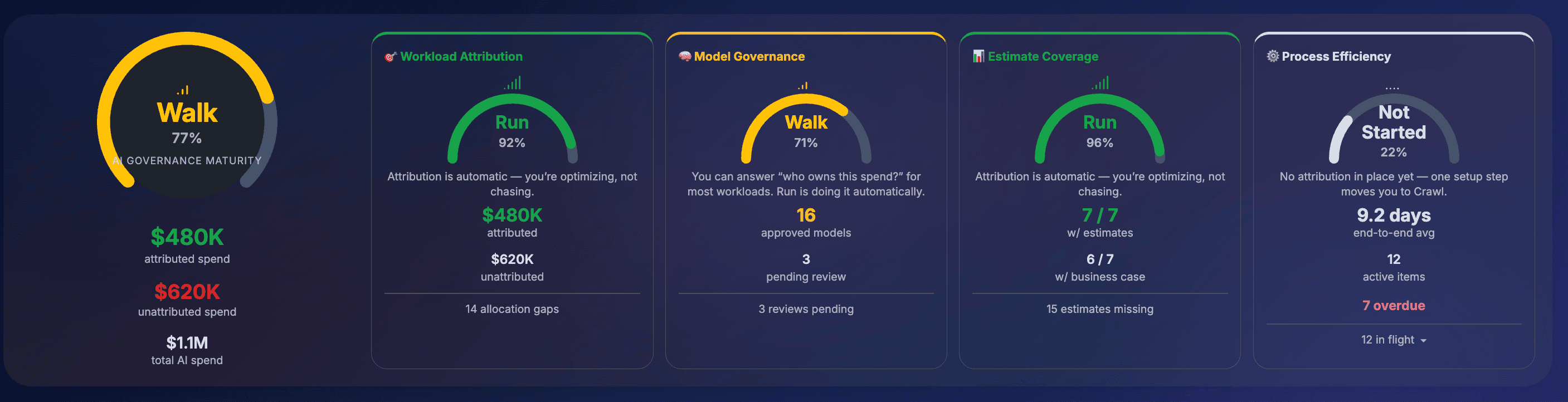
The AI Governance Scorecard: overall maturity tier with per-dimension gauges, current score, key metrics, and next advancement move for each category.
The Four Dimensions
Each dimension shows where you are
and what advancing is worth in dollars.
The percentage of AI spend attributed to a specific workload owner, where FinOps Center can answer "which application, and which budget owner, is responsible for this?" Attribution turns "this account spent $50K on AI" into "the Customer Support Bot spent $30K, the Document Platform spent $20K."
Claim the dedicated IAM role for each AI workload in Spaces and close Allocation Gaps where spend runs through broad shared SSO roles.
No workload claims. All AI spend sits at the account level with no workload owner.
Some roles claimed. A portion of spend attributes to named workloads, but most is still unattributed.
Most spend attributed. Finance can answer "who owns this?" for the majority of AI cost.
Claiming is routine. New workloads are claimed before the first API call. Attribution is automatic.
The percentage of active AI models that are approved for use, enabled in the accounts and regions where they are running, and free of governance gaps. Before governance, any developer can call any model in any account with no approval and no accountability. Model Governance is the gate.
Approve and scope models in active use, ensure each is enabled where it runs, and resolve Allocation Gaps flagging out-of-scope or unapproved usage.
No model approvals on record. Any model in any account can be called by anyone.
Some models approved. Active Allocation Gaps for unapproved usage. Governance is partial.
Most models governed. You can answer "who owns this spend?" for most workloads.
All active models approved. New models require a Business Request before first use.
A blended score across two signals: whether claimed AI workloads have a budget estimate set (70% weight), and whether they have a declared business case (30% weight). An estimate lets a Product Owner course-correct mid-period. A business case declares the value the workload is funded to produce. Reaching Run requires both.
Set an estimate for each workload missing one, using the Add Workload wizard in Spaces or the Business Request, and capture a business case at the same time.
No estimates set. AI spend is happening with no forward budget intent and no declared value.
Some estimates present. Coverage is partial. Most workloads still lack a budget anchor.
Most workloads have estimates. Business cases are present for some. Spend Cards are generating.
Estimates and business cases present for nearly all workloads as a matter of routine.
How quickly governance work moves from Business Request submission through FinOps Lead approval and Cloud Engineer enablement to a claimed, live workload. Governance that is slow becomes governance that gets bypassed. Keeping the cycle short is what keeps the whole model credible.
Clear overdue items in the Tasks and Business Requests queues, keep approvals moving promptly, and use the Priority flag for time-sensitive requests.
No process in place. Business Requests queue up without SLAs or tracking.
Process exists but is slow or inconsistent. Cycle times are long and overdue items accumulate.
Most requests clear within target SLAs. Some overdue items, but the queue is moving.
Governance cycle is fast and consistent. Teams view the governed path as the easy path.
Score Computation
Each category score is computed from role-scoped inputs: CUR attribution data, ModelApprovalTable, SpacesEstimatesTable, BusinessCaseTable, and BusinessRequestTable. Weights are configurable in FinOps Config. Scores update nightly when CUR data lands.
Estimate Coverage is the only dimension that blends two signals. The category score is 70% estimate coverage (claimed workloads with a confirmed budget estimate) plus 30% business case coverage (claimed workloads with a declared Cost Saving or Revenue Driving business case). A workload with an estimate but no declared value is not fully mature in this dimension.
See where your AI governance stands today.
The AI Governance Scorecard updates with every CUR load. Run the free assessment to see how your AWS AI estate scores across all four dimensions.