
Can Amazon Quick Suite Deliver on the Promises of Portal Technologies from 20 Years Ago?
As we have evaluated Amazon Quick Suite more deeply—particularly its implications for enterprise AI architectures—it has brought back striking memories of where enterprise application teams were 20 years ago. In the early 2000s, organizations were rapidly migrating from thick-client business applications running on AS/400s and mainframes to early-generation thin-client and web-based systems.
A Familiar Problem Returns in a New AI-Driven Era
As we have evaluated Amazon Quick Suite more deeply—particularly its implications for enterprise AI architectures—it has brought back striking memories of where enterprise application teams were 20 years ago. In the early 2000s, organizations were rapidly migrating from thick-client business applications running on AS/400s and mainframes to early-generation thin-client and web-based systems.
Business teams wanted modern, intuitive, consumer-grade interfaces. IT teams, meanwhile, struggled under the weight of a rapidly expanding portfolio of loosely standardized web applications, each reinventing authentication, authorization, and UI frameworks.
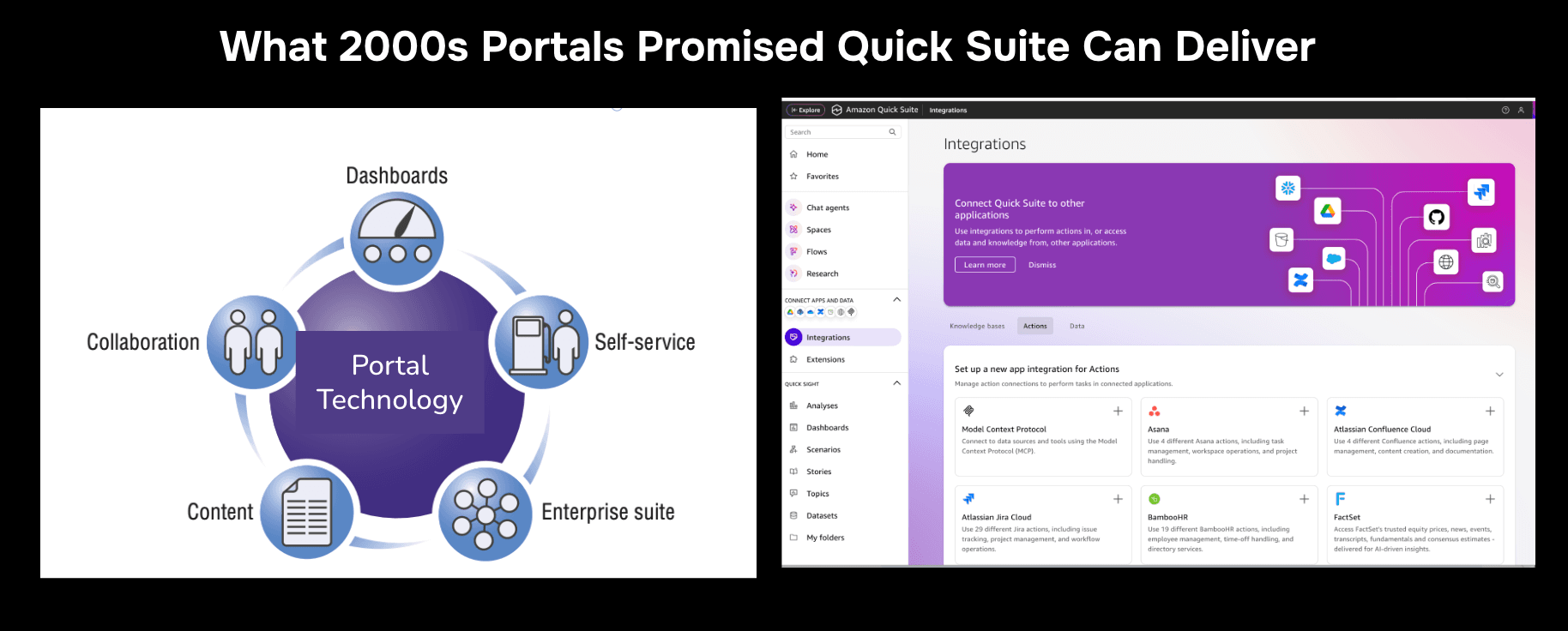
This fragmentation created operational and regulatory risks, eventually forcing large enterprises to adopt rigorous identity governance. It also gave rise to the Portal era—a centralized access point designed to unify People, Processes, Content, and Applications under a common IAM and UX model.
Two decades later, with AI Agents becoming the new application interface, we face a similar question:
How will enterprises provide a single, governed, unified access layer for AI-driven interactions across curated knowledge, enterprise data, and application workflows?
Amazon Quick Suite—despite originating from the QuickSight/BI lineage—appears increasingly well-positioned to answer that question.
What Enterprise Portals Tried to Solve
In the 2000s, Portal technology emerged to address several systemic challenges:
1. Identity & Access Fragmentation
Every application implemented its own authentication and role model. Ensuring that employees only had access to the right processes and data quickly became a compliance issue—one that regulators ultimately forced enterprises to prove through audits.
2. A Single Access Point for a Growing Application Portfolio
Portals promised unified navigation, consistent UI components, and centralized personalization.
3. Integration “at the Glass”
Portal teams tried to avoid rewriting applications. Instead, they focused on:
- Embedding UI components (“portlets”)
- Providing common look-and-feel
- Centralizing login and session management
- Surfacing BI content (reports, dashboards) inline
It worked—but at a cost. Portlets were heavy, often brittle, and rarely delivered truly collaborative or composable applications. They were static integrations, stitched together at the presentation tier and soon became extremely expensive to license and maintain in an emerging world of open source innovation.
Amazon Quick Suite: The Return of the Enterprise Access Layer—But Upside Down
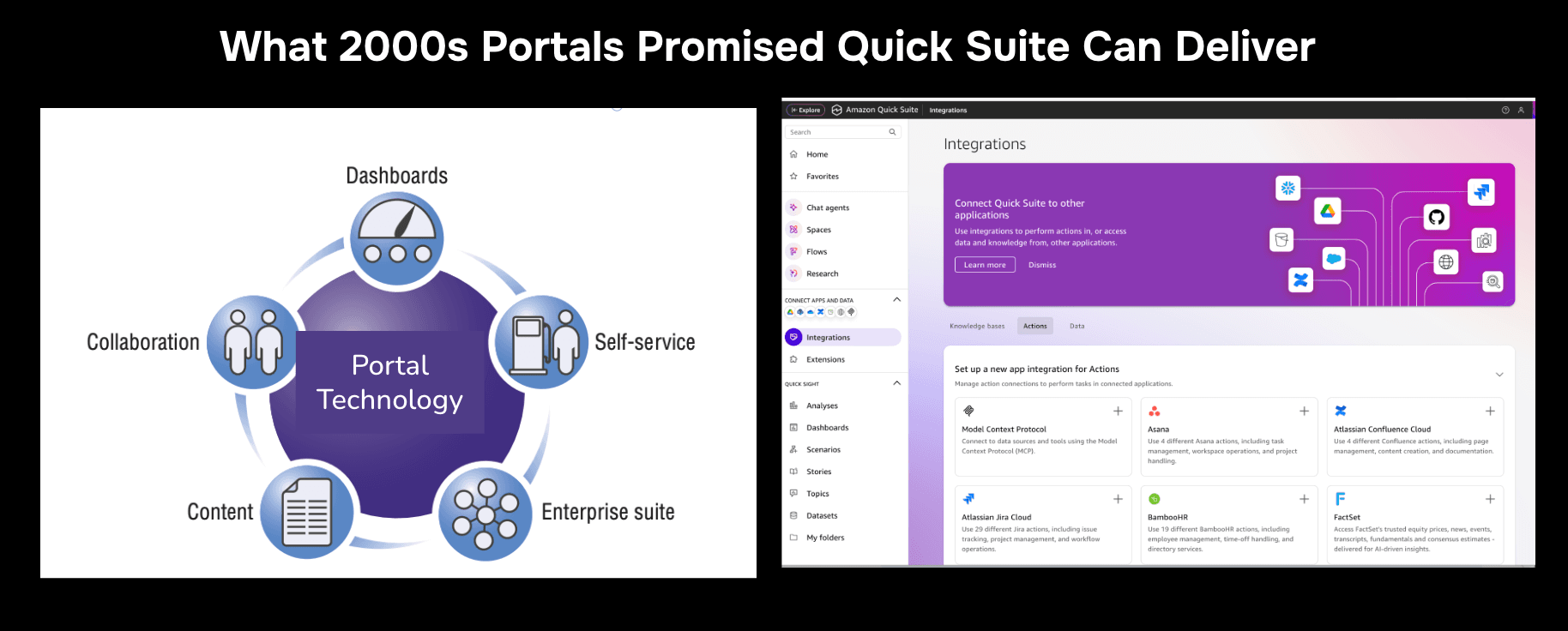
Although Quick Suite is branded as an evolution of QuickSight and BI capabilities, it is increasingly clear that it is far more than that. Quick Suite provides a functional equivalent to the Portal’s role as the enterprise’s centralized access point, but inverted for the AI era.
The key difference:
Instead of bringing applications into the Portal, Quick Suite brings a shared AI interface into every application.
QuickChat + Spaces = The New “AI Access Layer”
Two architectural concepts in Quick Suite are critical:
- QuickChat (Embedded QuickChat)
The user interface that exposes AI Agents, Muti-Visual Responses, and reasoning capabilities. - Quick Suite Spaces
The “resource containers” that define:
When you bind your MCP server or AgentCore Gateway/Runtime to a Space, every instance of QuickChat embedded in your applications automatically inherits that configuration.
This is the inversion of the Portal pattern:
- Portal era: bring applications into the centralized UI
- Quick Suite era: bring a unified AI interface into all applications
Applications stay where they are.
QuickChat orchestrates the interactions between data, processes, and AI-driven workflows.
The Identity Question: Still the Hardest Part
Just as in the Portal era, IAM remains the linchpin.
At the time of this writing (December 2025), the Quick Suite / AgentCore ecosystem does not yet support user-token pass-through to AgentCore Gateway or Runtime.
This means that while Spaces, QuickChat, and MCP-based integrations work, fine-grained authorization based on user identity, business role, or financial scope requires custom engineering.
This challenge is what we are solutioning and working on implementing with FinOps Center’s early integration of Embedded QuickSight Q&A:
- FinOps Center roles and application allocation define data-access scopes
- To join with Topics Data, user scopes/allocations must be exported to S3 viaCUR/Athena datasets
- Topics must embed Named Entities, Calculated Fields, and Custom Instructions that reflect each user’s entitlements
This solution works—and was one of the earliest large-scale implementations of embedded Q&A in the FinOps category—but it is not yet the frictionless “identity-aware agent” model that Quick Suite ultimately aims to deliver.
Agent Bill, FinOps Center, and the Emergence of Agentic FinOps
For more than six months, as we built the Agent Bill strategy for FinOps Center, we viewed our internal FinOps processes as “Agentic Tools” capable of being exposed through an MCP-driven Agent experience.
We had just begun to test our custom FinOps Center MCP server when Amazon announced AgentCore. Shortly after, Amazon introduced Quick Suite. With our alignment to AWS as a Technology Cloud Operation Competency partner and Select Tier with Amazon QuickSight Service Delivery designation, we quickly aligned to the native AWS Services vs building out own.
Together, these two announcements changed everything.
What Quick Suite + AgentCore Unlocks for FinOps Center
With Spaces + Embedded QuickChat:
- FinOps Center users can now access their existing Topics the same way they did with embedded Q&A
- The same QuickChat UI can now also access FinOps Center’s business processes through MCP-connected actions
- Any application that shares identity or context with FinOps Center can embed QuickChat and expose FinOps processes directly from within its workflow
- The “Agent Bill” layer becomes the unified conversational + procedural interface across the FinOps ecosystem
Again, identity remains the gating factor—but it is temporary.
User-token support, whether from AWS or engineered as a Cloud Scal3 extension, is inevitable.
When that happens, FinOps Center, Agent Bill, and Quick Suite will collectively deliver something enterprise architects have been chasing for two decades:
A single, governed, intelligent entry point to enterprise data and processes—achieved with dramatically lower cost and exponentially more capability than the Portals that came before it.
Why This Moment Matters
Twenty years ago, Portals promised:
- Centralized UX
- Consistent access control
- Unified navigation
- Personalization
- Surface-level integration
They delivered some of that, but only through large, complex programs that often took years to justify.
Quick Suite, in contrast, can deliver:
- A unified AI interface
- Natural language access to enterprise knowledge and data
- Application integration through MCP and AgentCore
- Low-code deployability
- Embedded cross-application workflows
- Rapid iteration in response to evolving AI capabilities
Enterprises that struggled to justify multi-million-dollar Portal programs can now implement a more powerful, more adaptive access layer in a fraction of the time.
Quick Suite can be the Portal We always Wanted
Amazon Quick Suite is not a BI extension.
It is not a dashboard product.
It is not “embedded Q&A 2.0.”
It is the foundation of a new enterprise access architecture—one built for Agentic workflows, AI reasoning, and application integration through MCP instead of heavy application modernization.
And just like 20 years ago, identity remains the key.
When user-token federation and entitlement mapping become first-class capabilities, Quick Suite will fully realize the long-promised vision of unified enterprise access—this time driven by AI, not by presentation-tier integration.
For Cloud Scal3, FinOps Center, and Agent Bill, this moment represents a rare convergence:
- A new AI-native access layer (Quick Suite)
- A new application integration framework (AgentCore + MCP)
- A mature FinOps process architecture ready to be “agentified”
When these pieces fully align, the result will surpass the Portal era’s goals with orders of magnitude less effort and exponentially more business value.
We are, once again, at the beginning of a platform shift.
Only this time, the Portal is not a destination—it is an embedded AI capability that travels with the user wherever they work.